
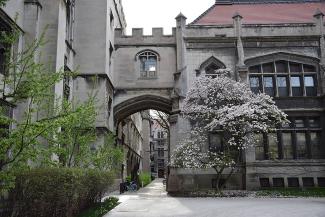
The Department of English Language and Literature is committed to theoretical and historical analysis of literature and culture. Consistently among the most popular classes among MAPH students, English courses cover a broad range of chronological periods, subfields, media, and genres. During their MAPH year, students can choose to pursue all of their coursework within the Department or limit their selection to just a few English courses. Students who take English courses also often enroll in courses in Art History, Cinema and Media Studies, Comparative Literature, Creative Writing, Philosophy, and Theater and Performance Studies.
Selected Faculty

Sample Courses
Breathing Matters: Politics and Poetics of Air (ENGL 50430) Autumn 2026
The participants in this seminar will be asked to re-examine the notion of “inspiration” in its aesthetic and historical senses, revisiting age-old textual and arts practices based on tropes of channeling, as well as contemporary practices based on embodied, performative and geopoetic notions of interconnection, circulation, receptivity and transmutation—including practices that reflect and refute the denial of the innate interconnectivity of beings. We will delve into the workings of air as an animating element that bridges and binds individuals to both internal and external forces—controllable and uncontrollable, state-sponsored and ambient, or what we would call “natural” under anthropocene conditions. We will examine the modern and contemporary politicization of air as a commons, and will apply our research to the analysis and critique of industrial and post-industrial landscapes. The imagination of air itself becomes central to thinking about utopian or dystopian collectivities in a time of respiratory crisis. Authors to be studied will include Coleridge, Shelley, Gerard Manley Hopkins, Mira Holzbachová, Ant Farm, Meredith Monk, M. NourbeSe Philip, Mladen Dolar, Cecila Vicuña, Adriana Cavarero, Jordan Scott, JJJJJerome Ellis, Achille Mbembe, and more. (Jennifer Scappettone)
Back to the Future: Modernity and Antimodernity Around 1900 (ENGL 34065) Winter 2027
Is modernity a blessing or a curse? Do visions of simpler forms of life bear lessons for the future, or are they idealistic—even dangerous—dreams? How have city life and mass media changed the way we interact with one another? Have we damaged our humanity in the name of technological progress? Questions of this kind are familiar today, at a time when the very foundations of modernity have once again come under critical scrutiny. This class will introduce students to a number of these writers from the rapidly modernizing U.S. at the turn of the twentieth century, as they asked about the dangers and possibilities of both utopian and critical takes on the modern world; likely candidates include Mark Twain, Sarah Orne Jewett, Charles W. Chesnutt, Charlotte Perkins Gilman, Henry James, Sui Sin Far, Frank Norris, Paul Laurence Dunbar, and Kate Chopin. To wit: Norris portrays a recent college graduate reduced to an animalistic state; Jewett records a dreamlike encounter with a rural world rapidly passing out of existence; Twain sends a modern engineer back in time to King Arthur’s Court; Chesnutt fictionalizes a real-life attempt by white supremacists to turn back time in the American South; Gilman imagines an all-female world in the wilderness; in James, a former New Yorker returns to his native city after decades to find it utterly transformed by the advent of the skyscraper. (Jennifer Fleissner)
In a Queer Time and Place (ENGL 47716) Winter 2027
In this class, we orient ourselves around the so-called “temporal turn” in queer and trans studies, which has produced some of the most exciting and influential queer theory of the last twenty years. We investigate queer theory’s bold interventions into the political and ideological workings of temporality alongside important works of queer and trans literature and film spanning the 1990s to the present. Our texts collectively interrogate the assumed naturalness of straight time and question the ways that heteronormative imperatives around things like maturity, generation, marriage, and progress dictate what counts as a good life, a future worth having, or a history worth remembering. Together we chart queer modes of engagement with history, the archive, the temporality of gender and sex performance, the pace and rhythm of human development, and the times and spaces of sex and intimacy. This class offers students a graduate-level introduction to queer theory and a good starting point for academic inquiry into c20-21 queer and trans literature and cinema. Theorists include Berlant, Cvetkovich, Edelman, Freeman, Halberstam, Keeling, Muñoz, and others; fiction and film by Jean Carlomusto, Samuel Delany, Cheryl Dunye, Isaac Julien, Torrey Peters, Justin Torres, Virginia Woolf, and others. (Agnes Malinowska)
Literature and Citizenship ENGL 40110 Winter 2027
What we think of as modernity can be said to begin with the birth (or rebirth) of the citizen. During the 17th and 18th centuries, revolutions in Britain, France, and North America sought to recast political society as a structure built upon social contracts and natural rights of the people rather than the divine right of kings. But this same era also saw the rise of transoceanic empires and chattel slavery. Its new republican governments generally excluded all but white men (and often all but white men who owned property) from the vote or from most spheres of political agency and authority. Indeed, the category of citizen was (and remains) exclusionary as well as inclusive, frequently deployed to mark those outside its boundaries and protections. During the 19th, 20th, and 21st centuries, the constructions of race, gender, and nation continued to shift into new forms, and many literatures of these centuries focus on how “the citizen” is conceived and reinvented into the present. This course will discuss how these tensions and debates influence literature and political discourse over four centuries, a breadth that will allow us to trace the concepts and critiques of citizenship as they have come to shape our contemporary world. (Megan Tusler, Tristan Schweiger)
Faeries, Demons, and Alchemists: Science, Magic, and the Supernatural in Early Modern England (ENGL 40458) Autumn 2026
This course aims to explore the messy territory between the scientific, the magical and the religious in the sixteenth and seventeenth century. Readings will draw on scholarship in the history of science, by writers such as Frances Yates and Steven Shapin, and on period reflections on the pursuit of knowledge by thinkers such as Francis Bacon, Thomas Browne Margaret Cavendish and Robert Boyle, as well as representations of occult knowledge in the period's literature. Readings may include Marlowe's Doctor Faustus, Shakespeare's Midsummer Night's Dream, Jonson's The Alchemist, selections from Spenser's The Faerie Queene, and Bacon's The New Atlantis. (Sarah Kunjummen)
Fictions of Personhood (ENGL 48617) Winter 2027
We consider how literary works reflect and shape historically shifting cultural and legal conceptions of personhood in the 20th century. What does literary character look like within a longer history of the novel, and what does it make of notions of free will, responsibility, and synthetic personhood. We read selections from Locke, Charles Taylor, Marya Schechtman, Galen Strawson, Joseph Slaughter, and Nihad Farooq, alongside novels by Laclos, Henry James, Somerset Maugham, HG Wells, Vita Sackville-West, Ralph Ellison, and Han Kang. (Darrel Chia)
See the English Department course page for additional courses and descriptions.
English Language and Literature Specialization
The English Language and Literature Specialization allows students to structure their coursework and thesis around the study of English within MAPH. Students who complete the following requirements will receive an English Language and Literature transcript notation:
- MAPH Core course (Foundations of Interpretive Theory)
- A minimum of four graduate-level English Department courses
- A thesis under the supervision of a member of the English Department Faculty
Please direct any questions you may have about specializing in English to maph-support@uchicago.edu.
Lawrence Grauman Jr. Fellowship Fund
The Grauman Fellowship, made possible by a generous legacy gift from Lawrence Grauman Jr. (AM '63), supports MAPH students studying English and/or Creative Writing, with a strong preference whenever possible for students who focus their studies on nonfiction writing or literary journalism.
MAPH applicants who plan to work on creative nonfiction or literary journalism can indicate an interest in the Grauman Fellowship on their application.
Recent English Thesis Projects
"Eating Between Worlds: Culinary Confinement and Diasporic Bodies in Literatures from the Global South"
Hongyu Chen, MAPH '26
Advisor: Kaneesha Parsard
"Spatial Transdiegesis and the Pulp Novel: Reading Space in Cornell Woolrich’s The Bride Wore Black"
Wilson Li, MAPH '26
Advisor: Bill Brown
"Meaning, Subjectivity, and Suicide in Kaveh Akbar’s Martyr!"
Samuel McFerron, MAPH '26
Advisor: Tristan Schweiger
“Time Passes into the New Woman: An Analysis of Sophocles and Woolf”
Maria Simms, MAPH ‘25
Advisor: Sarah Kunjummen